Psst — the thrift-hunt version of this guide lives as a visual story: View this as a Web Story
I walked into my local thrift shop last month looking for nothing and walked out with a brass table lamp I did not need. It is still sitting on my dresser, unplugged, because the socket is cracked and a rewire would cost more than the lamp did. That lamp taught me the lesson this whole guide is built on: thrifted décor only works when you hunt with a list. Buying random “cute vintage stuff” is what fills homes with clutter instead of character — and the clutter versions of thrifted rooms are the ones that never make it onto anyone’s mood board.
Here is why this matters right now. Pinterest’s Autumn 2026 trends report, published just about a day ago, shows searches for “dream thrift finds” up a staggering 550% among Gen Z shoppers aged 18-24. Half a million more people than last fall are suddenly combing thrift racks and estate-sale boxes for home décor — and most of them, in my experience, are going to come home with the equivalent of my broken brass lamp. They will buy the odd candlestick, the quirky plate, the little statue with no eyes, and wonder why their living room still feels like a storage unit.
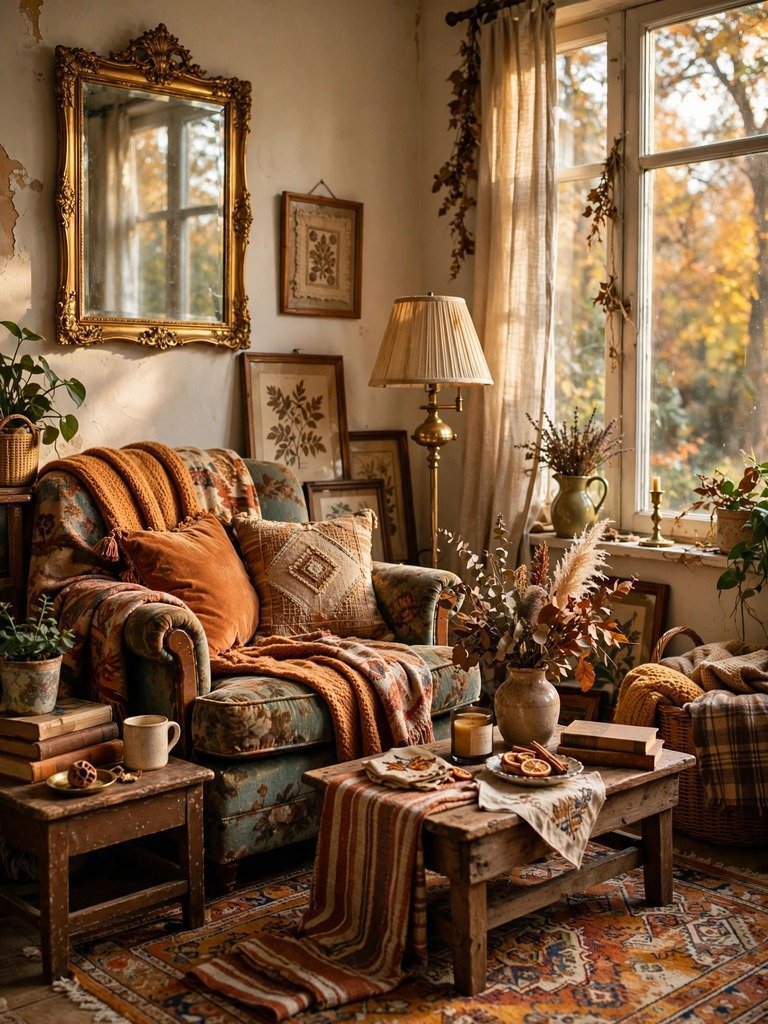
I have been thrifting for home décor for years, and I will give you my honest opinion up front: about 90% of what is on a thrift shelf should stay there. The magic is in the other 10%, and nearly all of it falls into five categories. Hunt for the chair, the mirror, the lamp, the wall art, and the textile — learn to judge those five, skip everything else — and you will build a home that looks collected instead of accumulated. That is the whole game. Everything below is how I play it.
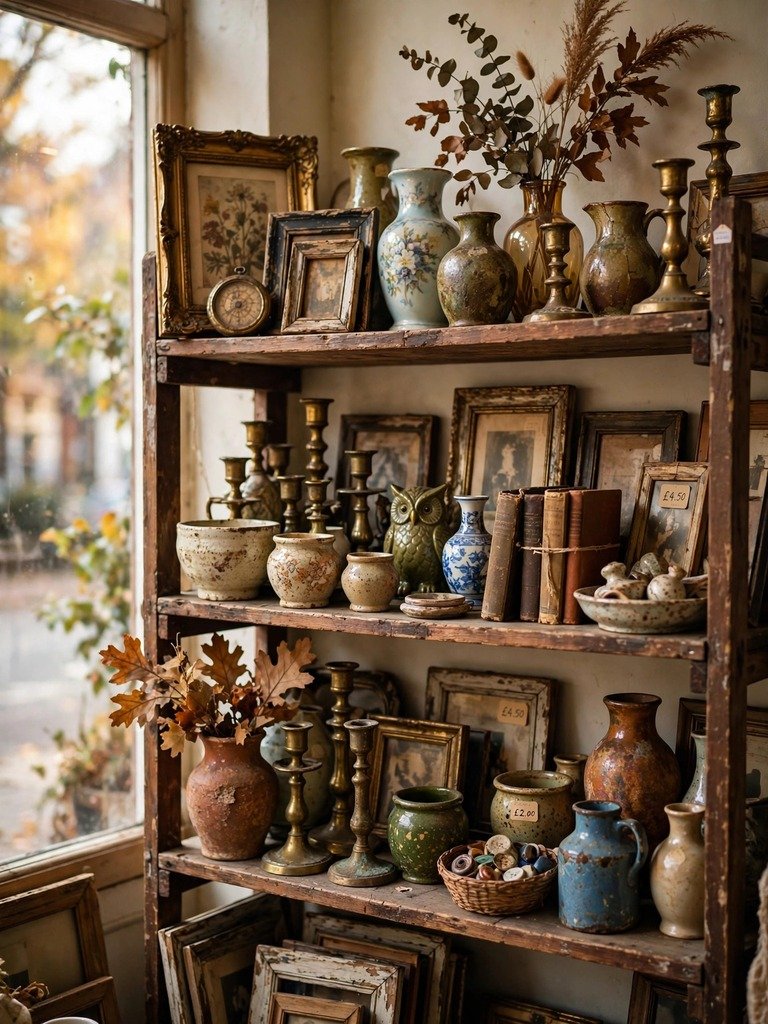
How Thrifting for Decor Actually Works
Before the five pieces, you need the method, because thrifting without a method is just expensive wandering. Here is my quick-start routine — the one I would hand to a friend who has never done this before.
Go on restock days. Most thrift shops put out fresh donations on weekday mornings, typically Tuesday through Thursday. I have found my best pieces around opening time on a Wednesday, when the weekend’s donations have been sorted and the resellers have not yet picked through them. Saturdays are, frankly, picked-over and stressful — this is the one place in décor hunting where showing up early on a boring weekday beats the weekend crowd every time.
Do the smell test. Pick up upholstered items and wood pieces and smell them. Smoke, heavy mildew, and pet urine do not come out — no amount of airing fixes them, and reupholstering costs more than buying new. This only works if you are honest with yourself: if you catch yourself thinking “I can probably get this smell out,” put it down and walk away. I have been wrong about this exactly once, and it cost me a velvet armchair I ended up donating back to the same store six months later.
Use your phone flashlight. Hold it at a low angle across wood, metal, and glass. This raking light exposes scratches, dents, repaired cracks, and wobbly veneer that overhead store lighting hides. A mirror’s silvering loss, a chair’s hairline leg crack, a lamp’s worn cord — the flashlight finds all of it in ten seconds. Do this before you fall in love with a piece, not after.
Measure before you buy, every single time. I keep a tape measure in my bag and the room dimensions of my key walls in my phone notes. That perfect mirror means nothing if it is four inches wider than the wall above your console table. Tape-measure the piece, check your notes, and only then decide. Eyeballing sizes in a store is how side tables end up living in hallways where nobody wanted them.
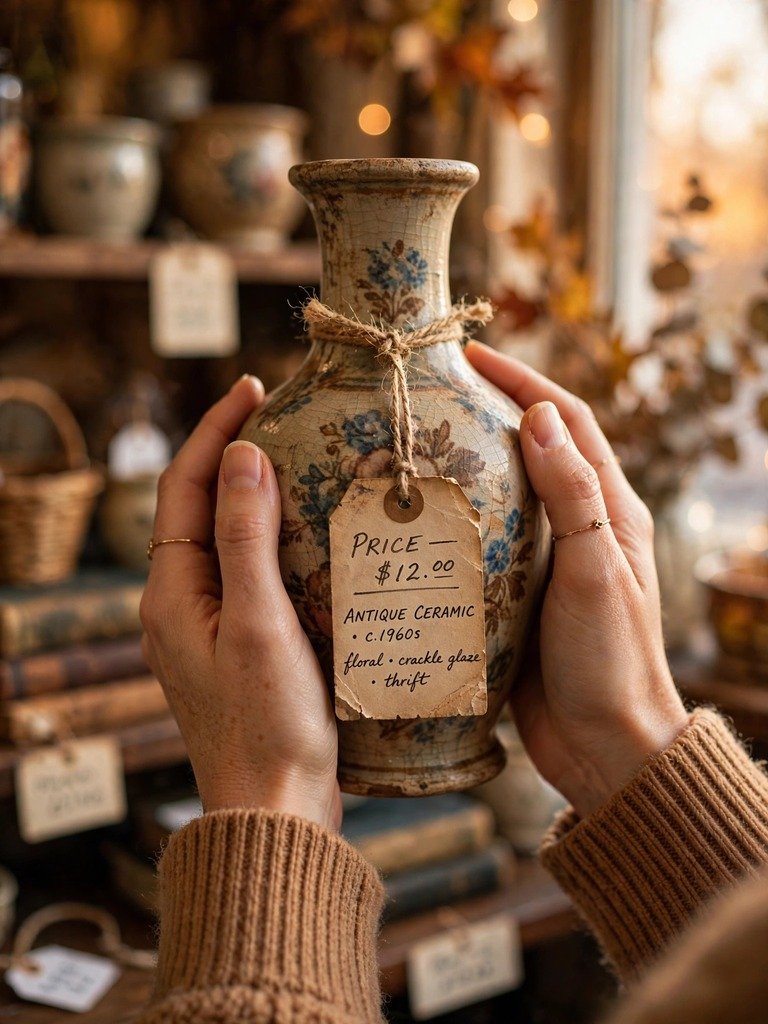
With those four rules as your filter, the hunt narrows beautifully. You stop looking at everything and start scanning for five shapes. Here they are.
1. The Chair
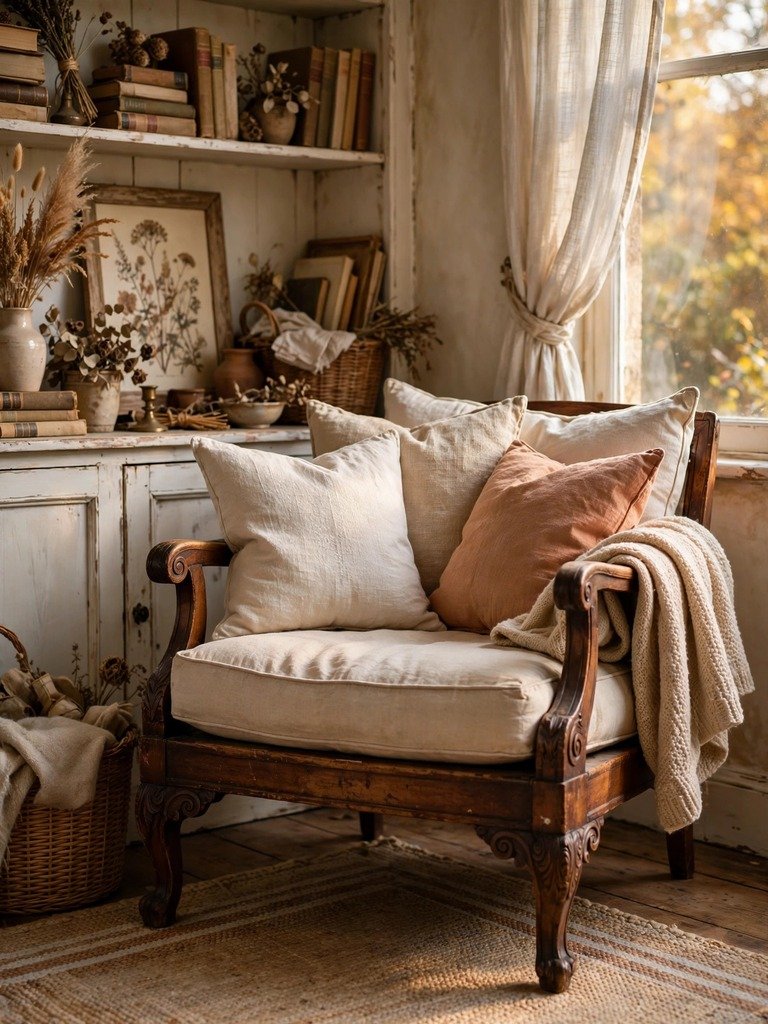
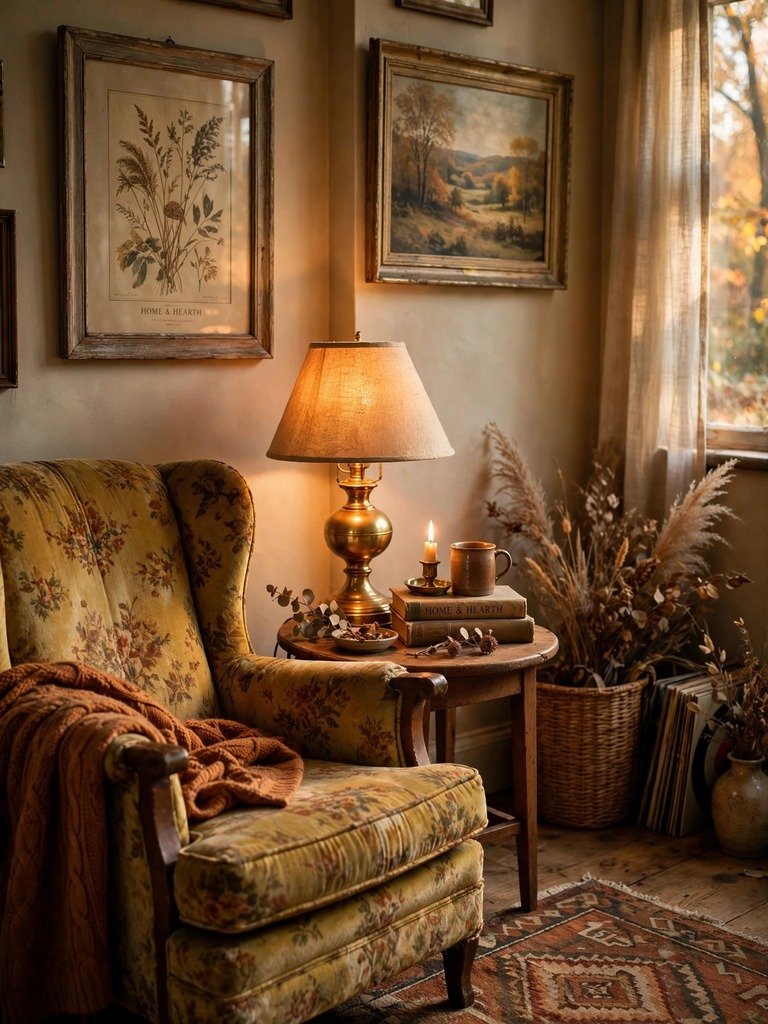
A single great thrifted chair changes a room faster than almost any other purchase, new or used. Chairs are the backbone of a collected interior: they give a corner a purpose, they photograph beautifully, and unlike sofas, one odd chair never looks like a mistake.
What to look for: Solid wood frames — real oak, teak, or mahogany — with joinery that still feels tight when you sit and shift your weight. Mid-century armchairs with good bones, sturdy wooden dining chairs, and small accent chairs in interesting silhouettes are the winners. I would always pick a chair with a tired but intact cushion over one with a great cushion on a wobbly frame, because cushions are cheap to replace and frames are not. Skip anything that rocks, creaks loudly, or has a crack through a load-bearing joint — that is structural, not cosmetic, and it will fail on a guest.
Price sanity: A solid wooden accent chair in good shape typically runs $15–40 at a thrift shop. If the price tag says $60+, it should be genuinely special — a designer label, exceptional condition, or unusual provenance. For fall, I hunt chairs in warm browns and ambers, which slot straight into the season’s palette. If you are building a fall 2026 look, my guide to warm brown décor ideas shows exactly how one wooden chair anchors the whole room’s color story.
2. The Mirror
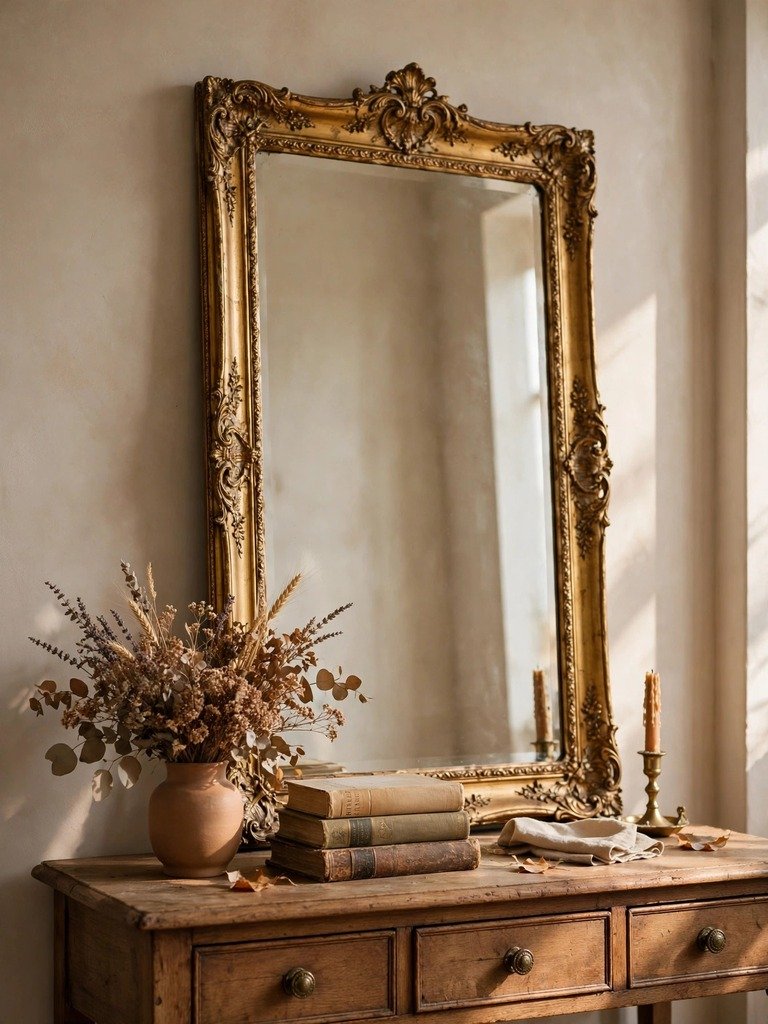
Vintage mirrors are, in my opinion, the single most underpriced category in any thrift store. A big mirror with a real wood or brass frame costs a fraction of its retail twin, bounces light around a dark fall room, and makes small spaces feel twice their size. New mirrors this good start at five times the thrift price — this is the one category where the thrift version is not a compromise, it is the smart buy.
What to look for: Heavy frames (weight usually means real wood or metal, not resin), glass that is clear from straight-on even if the edges show a little foxing — light antiquing at the corners is character, not damage. Hold it up and check that the backing is intact; flaking silvering across the middle of the glass is the only real dealbreaker. What to skip: frameless bathroom mirrors and anything with the glass visibly separating from its backing — both are replaceable-for-cheap new, so there is no thrift advantage.
Price sanity: $10–30 for a medium statement mirror is the sweet spot. Anything under $10 in a decent frame, I buy on sight — mirrors are the piece I never regret.
3. The Lamp
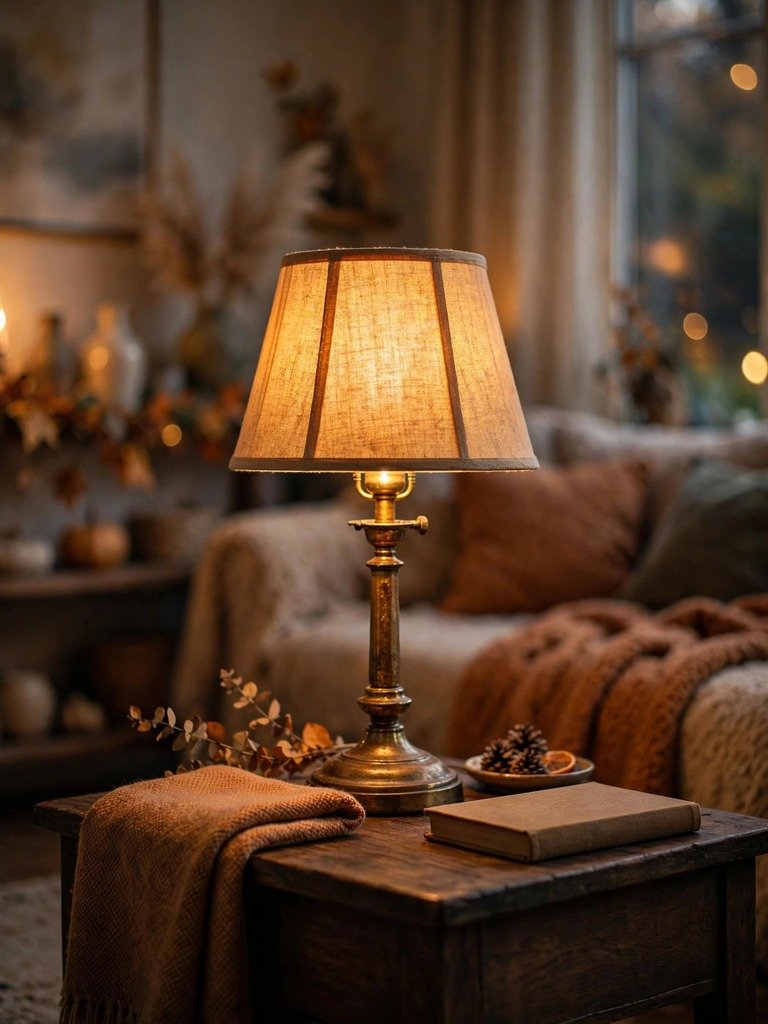
Lamps are where thrift stores quietly beat every big-box retailer. A new table lamp with real brass, ceramic, or carved-wood body costs serious money; the thrift version costs lunch money, and the shade is almost always the part that looks tired. Here is what I would do: buy the lamp for its base, plan to replace the shade, and you have a $100+ look for under $25.
What to look for: Heavy bases that do not wobble, sockets that click firmly when you turn them, and cords with no cracking or exposed wire. Ceramic ginger-jar lamps, brass pharmacy lamps, and sculptural mid-century table lamps are my three recurring winners. What to skip: anything with a cracked socket housing or a frayed cord near the plug — my broken brass lamp is the cautionary tale here. Rewiring costs $30–50 at a lamp shop, which kills the deal on a $12 lamp.
Price sanity: $8–20 for a table lamp with a good base is fair. Budget another $15–25 for a new drum shade, because the original shade is nearly always the dated part. For fall evenings, pair a thrifted lamp with something moodier on the walls — I have been layering lamplight with the deep, starry palette from my extra-celestial décor guide, and the combination makes even an ordinary Tuesday feel atmospheric.
4. The Wall Art
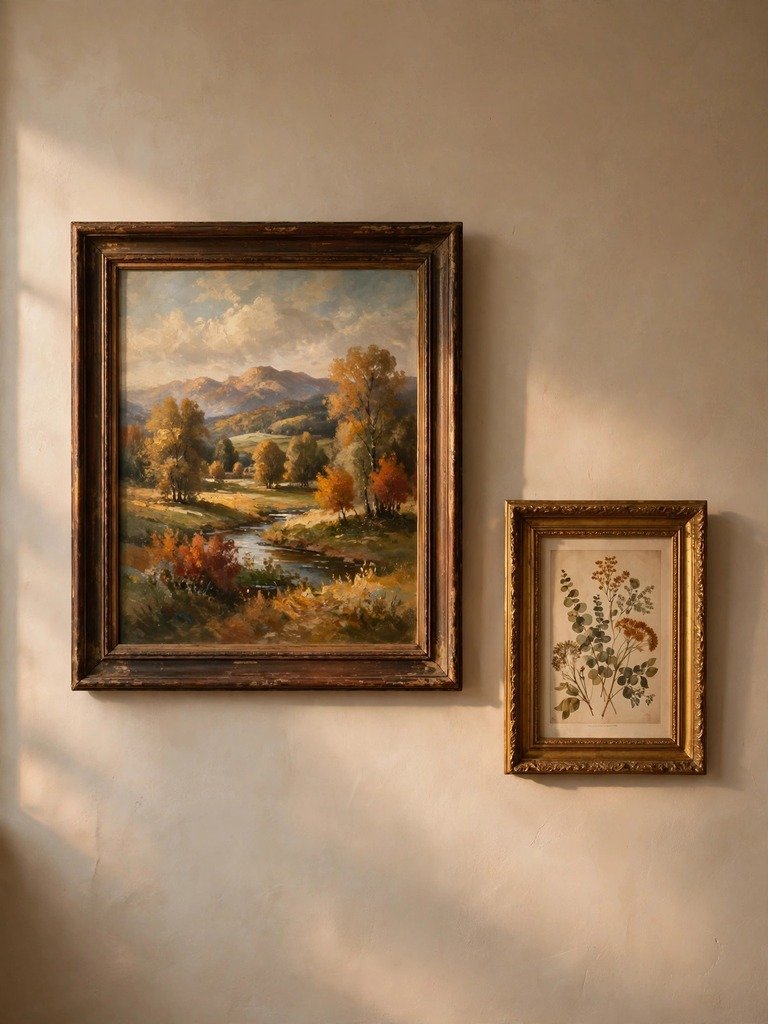
Thrift-store art is the category people misunderstand most. They walk past the art wall because half of it is mass-produced hotel prints in plastic frames — and they miss the originals hiding between them. I have found genuine oil paintings, hand-pulled prints, and hand-embroidered textile art for the price of a coffee, because thrift pricers rarely know what they are looking at.
What to look for: Actual paint texture (run your finger lightly over the surface — real brushstrokes mean a real painting), signatures in the corner, gallery labels or exhibition stickers on the back, and solid wood frames that are worth more than the art inside them. Even if you do not love the painting, a great frame is a find — frame a thrifted print in a thrifted frame and you have a gallery piece for $10. What to skip: anything under glass that looks flat and glossy (usually a reproduction), and canvases with mildew spots or water stains that go all the way through — those do not clean up.
Price sanity: $5–25 for framed originals is normal. If you are styling an eclectic fall wall, the layered, pattern-rich pieces also pair beautifully with an afrohemian décor scheme — thrifted art is practically the engine that style runs on.
5. The Textile
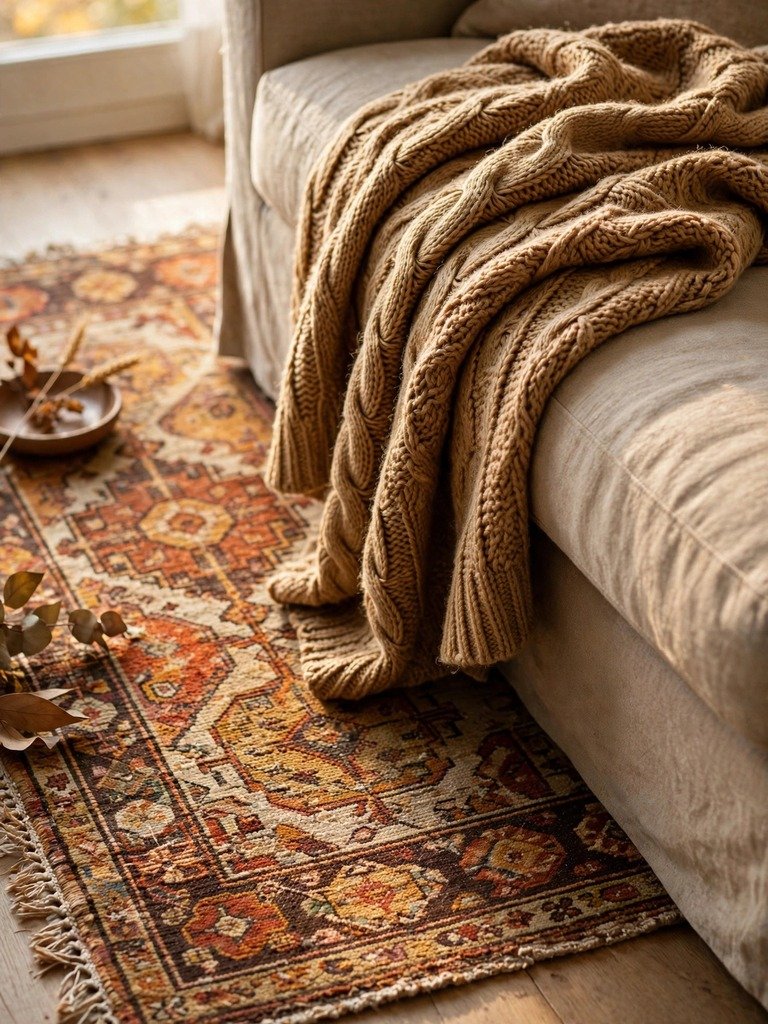
Thrifted textiles are my sleeper pick for fall. Wool throws, linen tablecloths, embroidered cushion covers, and hand-loomed rugs appear constantly, because textiles are the thing people donate when they redecorate — and they are the easiest thing to wash back to life. A $6 wool throw in a rust or ochre tone does more for a fall living room than most $60 new accessories.
What to look for: Natural fibers — wool, cotton, linen — which you can check with a quick burn-free trick: rub the fabric and feel for warmth (synthetics feel plasticky and cold). Look for tight weaves, intact fringe, and colors that have faded evenly rather than in blotches. What to skip: anything with a musty smell that survives a squeeze-and-sniff, thinning spots that will tear, and “dry clean only” pieces with visible stains — the cleaning bill erases the bargain.
Price sanity: $3–12 for throws and cushion covers, $20–50 for a genuine hand-knotted or hand-loomed rug (check the back — real knots mean real value). Wash everything on a gentle cycle with vinegar before it touches your sofa; this one habit makes thrifted textiles feel completely yours.
What I’d Skip
This section matters as much as the five finds, because the difference between a curated thrifted home and a cluttered one is entirely about what you leave behind. Here is my personal skip list — the categories I pass on no matter how tempting they look on the shelf.
Anything that needs professional restoration. A chair that needs re-caning, a lamp that needs a full rewire, a painting that needs conservation — if the fix costs more than the piece’s thrift price, it is not a bargain, it is a project, and projects have a way of living in garages for three years. I buy pieces I can use this weekend. If it needs a specialist, I skip it. This is the judgment call that will save you the most money over a year of thrifting.
Matching sets of “vintage-look” smalls. The clusters of identical brass candlesticks, the boxed sets of etched glasses, the porcelain figurine families — they read as clutter within a week. One brass candlestick with a story is décor; six identical ones are inventory. I allow myself exactly one small decorative object per trip, and only if it fits one of my five categories’ world.
Upholstered furniture you cannot fully clean. Sofas and armchairs with fixed, non-removable covers and a questionable smell are the riskiest thrift purchase in existence. Bed bugs, deep smoke, pet dander — some of these are real health concerns, not just aesthetic ones. I will buy a wooden chair with a cushion I can replace; I will not buy a fully upholstered sofa I cannot inspect inside. If you cannot see and smell every layer, skip it.
Trendy reproductions priced like originals. Some shops now price mass-produced “farmhouse” and “boho” décor at near-retail. A $25 mass-market sign that sells new for $30 is not a thrift find — it is just a used sign. The 550% search surge means more competition on the shelves, so always sanity-check prices against what the item costs new. Thrifting wins on quality-per-dollar, never on hype.

Bring Home Character, Not Clutter
Here is my closing thought after years of doing this: the best thrifted homes are not the ones with the most vintage pieces — they are the ones where every vintage piece earned its place. One good chair, one honest mirror, one lamp with a new shade, one painting that stopped you mid-aisle, one throw in the exact color of October light. Five pieces, chosen with a method, will do more for your home than fifty impulse buys ever could.
Start this fall with a list, a tape measure, and your phone flashlight. Go on a Wednesday morning, sniff before you love, and remember that the goal is not to fill a room — it is to find the few things that make the room feel like it has a past. That is what the 550% surge is really about, underneath the trend numbers: people are tired of rooms that look like catalog pages. They want rooms with stories. Now you know exactly which five stories to hunt for.
By Mehboob Hussain
Mehboob Hussain is the founder and editor of MubStyle, where he covers fashion, beauty, home decor and wellness. He personally reviews and edits every article on MubStyle, and directs the original visuals for each guide. Based in Multan, Pakistan.
Frequently Asked Questions
Can thrifted furniture bring bed bugs into my home?
It is a real risk with upholstered pieces, which is exactly why I skip sofas and armchairs I cannot fully inspect. For wood, metal, and glass items, a thorough wipe-down with soap and water plus a day in bright sunlight handles virtually all concerns. For textiles, a hot wash and high-heat dryer cycle kills bed bugs and their eggs. When in doubt, quarantine the piece in a garage or balcony for a few days before bringing it inside.
How do I clean vintage finds without damaging them?
Start gentle and escalate only if needed: a soft cloth with warm soapy water handles most wood and ceramic. For brass, a paste of lemon juice and baking soda works beautifully — just rinse and dry immediately so it does not spot. Never soak old wood, never bleach vintage textiles, and test any cleaner on a hidden spot first. Patina is character; over-cleaning a piece until it looks new is how you erase the very thing that made it worth buying.
Can I negotiate prices at thrift stores?
At charity-run shops, prices are usually fixed — and haggling there feels wrong to me anyway, since the money goes to a good cause. At flea markets, estate sales, and vintage fairs, negotiating is expected: I offer about 20% below the asking price late in the day, when sellers would rather sell than pack up. Being friendly and buying multiple items gets you further than aggressive bargaining ever will.
What are the best days to go thrifting?
Weekday mornings, Tuesday through Thursday, right when the store opens. That is when fresh donations hit the floor and before resellers clear the best stock. Estate sales are best on their first morning for selection, and best on their last afternoon for discounts — many drop prices 50% on the final day. I avoid weekends entirely unless I am just browsing for fun, because the good stuff is long gone by Saturday afternoon.
What should beginners absolutely avoid buying?
My top three avoid-list items: anything with a smell you cannot identify and remove (smoke and mildew never leave), anything with a structural crack you cannot see all the way through, and anything that needs a professional repair costing more than the piece itself. Also skip the small decorative clutter — the figurines, the novelty mugs, the “quirky” wall plaques — until you have your five key pieces sorted. Clutter is what happens when you shop without categories.
How do I make sure a thrifted piece actually fits my space?
Keep your room’s key measurements in your phone — wall widths, ceiling height, the footprint where a chair or side table would go — and carry a tape measure. I also snap a photo of the spot the piece is meant for before I leave home, so I can compare tones and scale in the store. The classic beginner mistake is buying a mirror that is four inches too wide for its wall; the tape measure is the cheapest insurance in thrifting.
How do I mix thrifted vintage pieces with new furniture?
The rule I follow is 70/30: let about 70% of a room be your comfortable modern base and let 30% be the vintage character pieces. The vintage items should share something — a wood tone, a metal finish, a color family — so they read as intentional rather than random. One thrifted wooden chair next to a modern sofa works because the chair is the accent; five mismatched thrifted chairs next to it reads as a waiting room.
I regret a thrift purchase. What should I do with it?
First, stop buying for a month and figure out what went wrong — usually it was no measurements, no smell test, or no category. Then rehome the piece: donate it back, list it on a local marketplace, or gift it to a friend whose style it actually suits. I once donated a chair back to the exact store I bought it from, and I do not consider that a failure — it is tuition. Every thrifter pays it; the good ones just pay it once per lesson.
Loved the hunt? See all five finds styled in motion: View this as a Web Story

Mehboob Hussain is the founder and editor of MubStyle, where he covers fashion, beauty, home decor and wellness. He personally reviews and edits every article on MubStyle, and directs the original visuals for each guide. Based in Multan, Pakistan.