The Only 5 Pieces You Need for the Khaki Coded Look (Fall 2026)
By Mehboob Hussain
When Pinterest dropped its Predicts 2026 report and I saw “Khaki Coded” sitting there among the top trend predictions, my first reaction was honestly a groan. Another theme-dressing trend? Was I supposed to start dressing like I was about to film a nature documentary? I nearly skipped covering it altogether.
But then I did what I always do — I spent an evening scrolling through what people are actually saving under this trend, not the mood boards, the real street-style pins. And I changed my mind completely. Here is my opinion, stated plainly: Khaki Coded is not safari cosplay. Strip away the styling on those pins and what you find is just genuinely great basics in desert tones — a good utility shirt, a solid jacket, trousers with a real shape, boots that age well. The trend works because the clothes underneath it are classics.
That is the judgment call I want you to make before you spend a single rupee: this only works if it looks like your own clothes in desert tones, never a costume. Skip the matching head-to-toe safari set with the epaulettes. You do not need it, and it is the one version of this trend that reads as a Halloween outfit by week two. The good news? You probably own three of the five pieces already, sitting in your closet right now. I tested this whole look over two weeks with my own wardrobe, and here are the five pieces that carry it — and the five rules that keep it sharp.
Piece 1: The Utility Shirt (With Real Pockets)
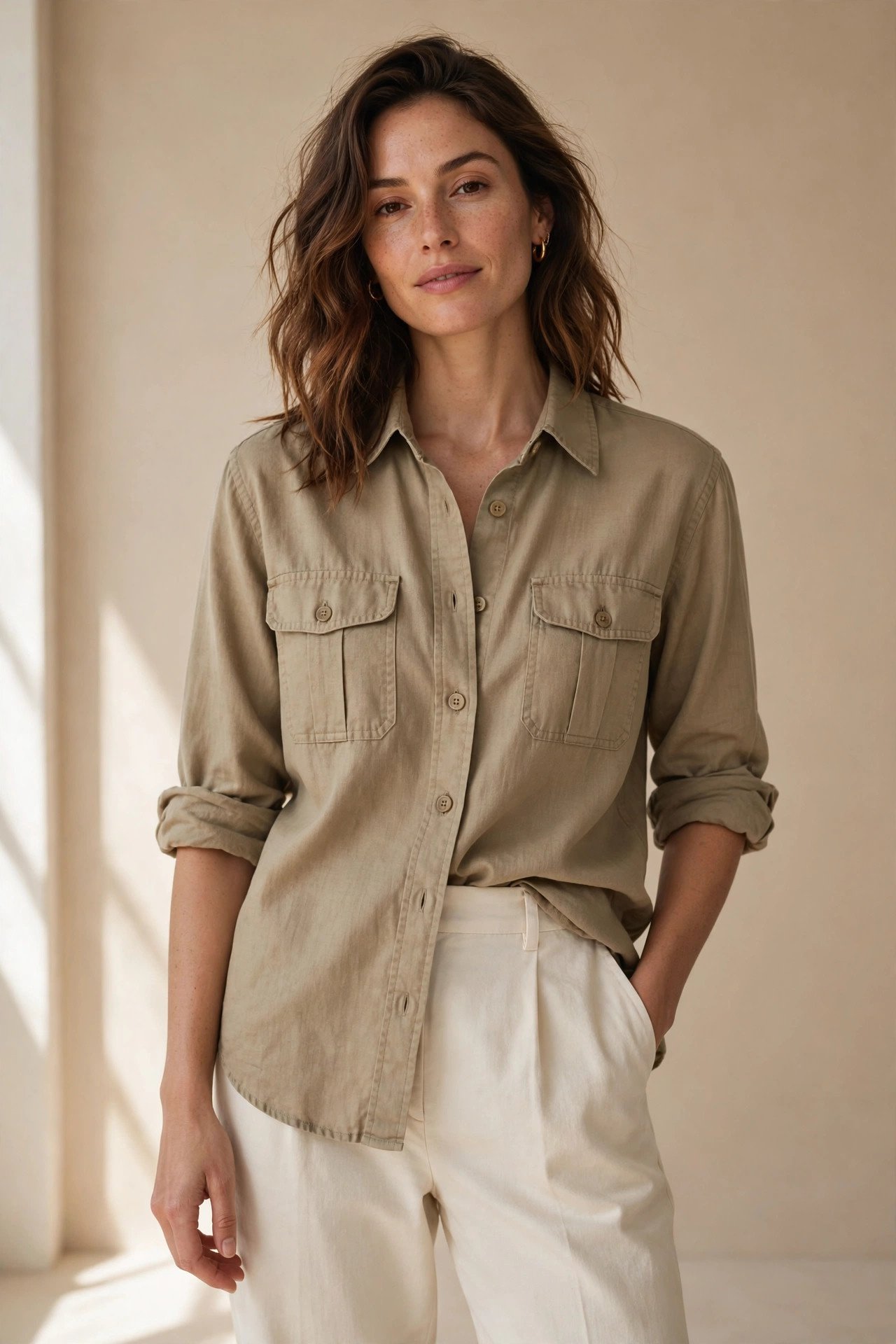
The utility shirt is the engine of the whole Khaki Coded look, and I would not build the trend without it. Look for a relaxed button-up in true khaki or faded olive with two genuine chest flap pockets — not decorative flaps sewn flat, but pockets you can actually use. I have tested both, and the real pockets make the shirt drape like it means something; the fake ones just look costume-y up close. Cotton twill or a cotton-linen blend is the fabric you want — it wrinkles just enough to look lived-in without looking sloppy. Here is what makes this piece earn its place: it works three ways. Tucked into pleated trousers, it is a proper outfit. Untucked over a plain tee with the sleeves pushed up, it is a light jacket. Thrown open over a dress, it becomes the layering piece that ties the whole palette together. Buy it slightly oversized — one size up from your normal fit — because a utility shirt that pulls at the buttons defeats the entire relaxed point of this trend.
Piece 2: The Field Jacket (Your Only Outerwear)
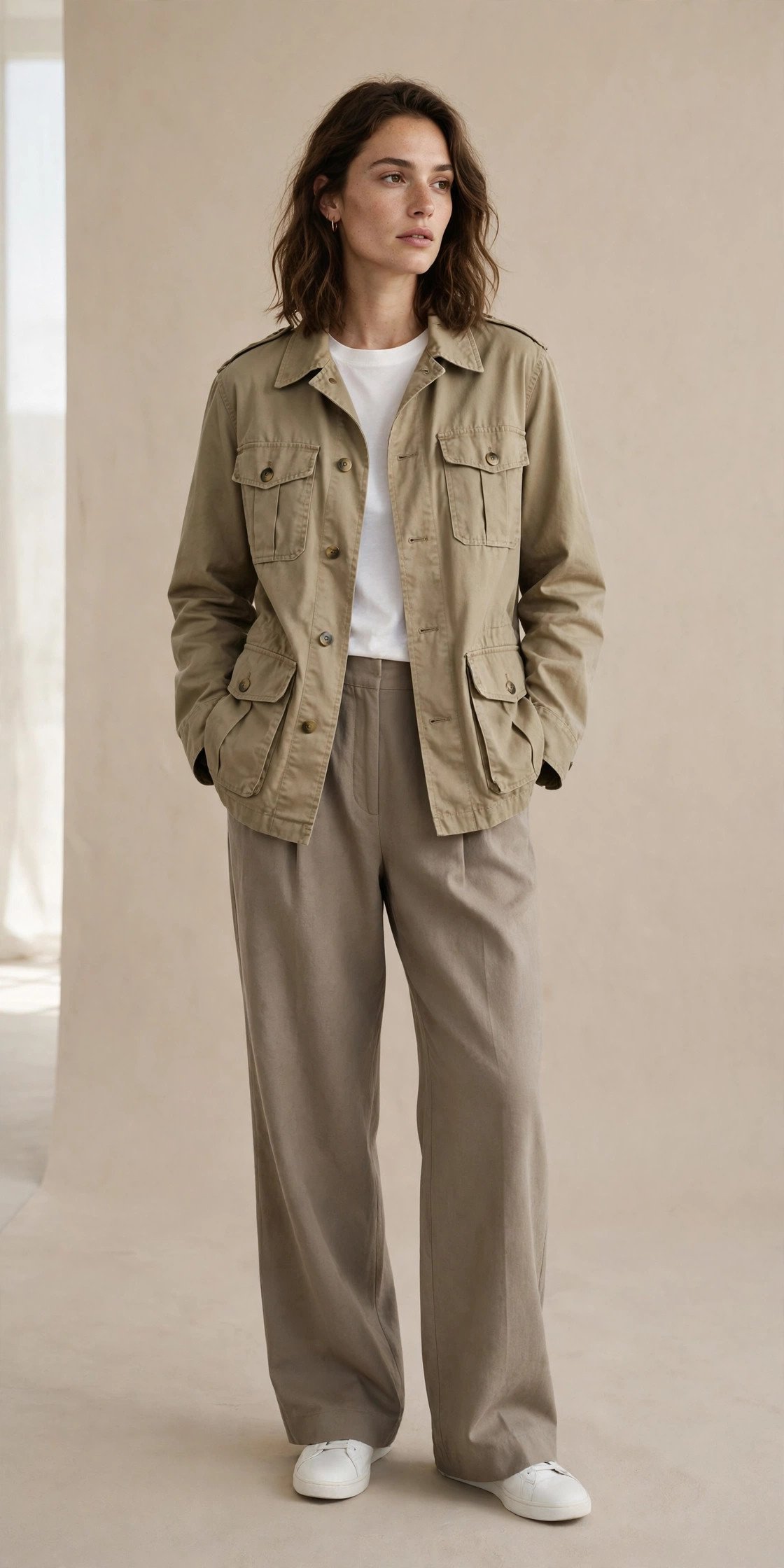
If the utility shirt is the engine, the field jacket is the statement. One good field jacket in sand or stone khaki covers every outerwear need this look will ever ask of you, and I say that as someone who owns too many jackets. The details matter more than the brand: four bellow pockets, a storm flap over the front, a drawstring or belted waist, and a length that hits mid-hip to just below the hip. Shorter and it reads cropped-trendy; longer and it starts looking like actual field gear. My judgment call on this one — this is the one piece I would buy new if you do not own it, because a field jacket in the wrong khaki (too yellow, too green) throws off every outfit underneath it. Hold it up in daylight before you commit. The right shade sits somewhere between dry sand and wet stone. Wear it open over everything for the first month; the jacket does the talking, and the simpler everything underneath is, the more expensive the whole outfit looks.
Piece 3: Pleated Khaki Trousers (The Shape That Matters)
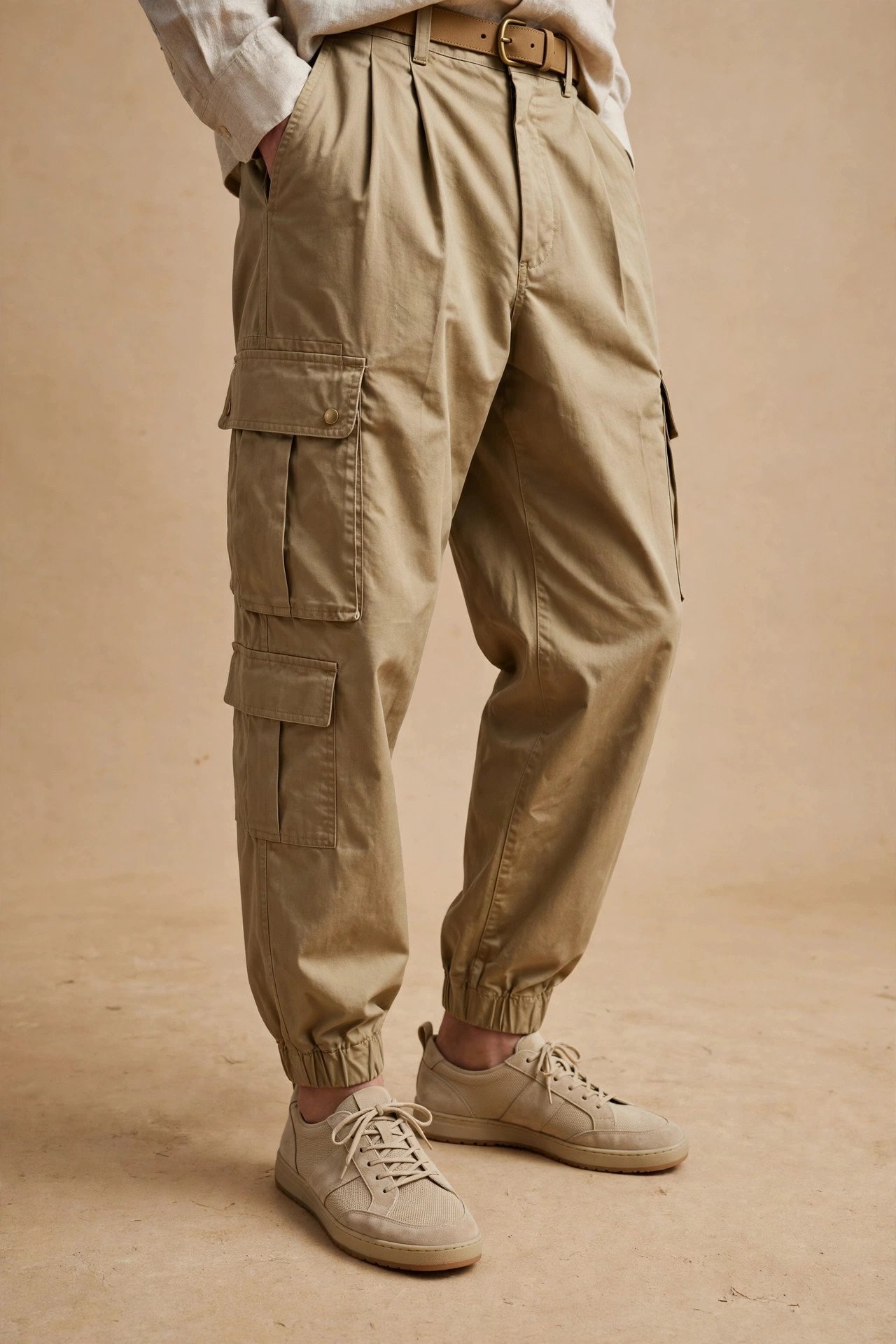
Trousers are where Khaki Coded quietly succeeds or fails, and the difference is all in the silhouette. Skinny khaki pants with a safari shirt is exactly the costume look we are avoiding. What you want is volume with structure: pleated fronts, a higher rise, and a leg that tapers gently toward the ankle. Cargo pockets are optional but I like them — one clean side pocket per leg adds the utility character without tipping into tactical territory. In my experience, the pleat is doing more work than people realize: it gives the fabric room to move, which is what creates that relaxed, unstudied line down the leg instead of fabric clinging and creasing in all the wrong places. Go for a mid-weight cotton twill that holds a crease. And here is a practical note from testing: khaki trousers show every wrinkle, so hang them, never fold them, and give them one good steam before the week starts. Five minutes on Sunday saves the whole look.
Piece 4: Suede Desert Boots (Or Loafers, If That Is You)
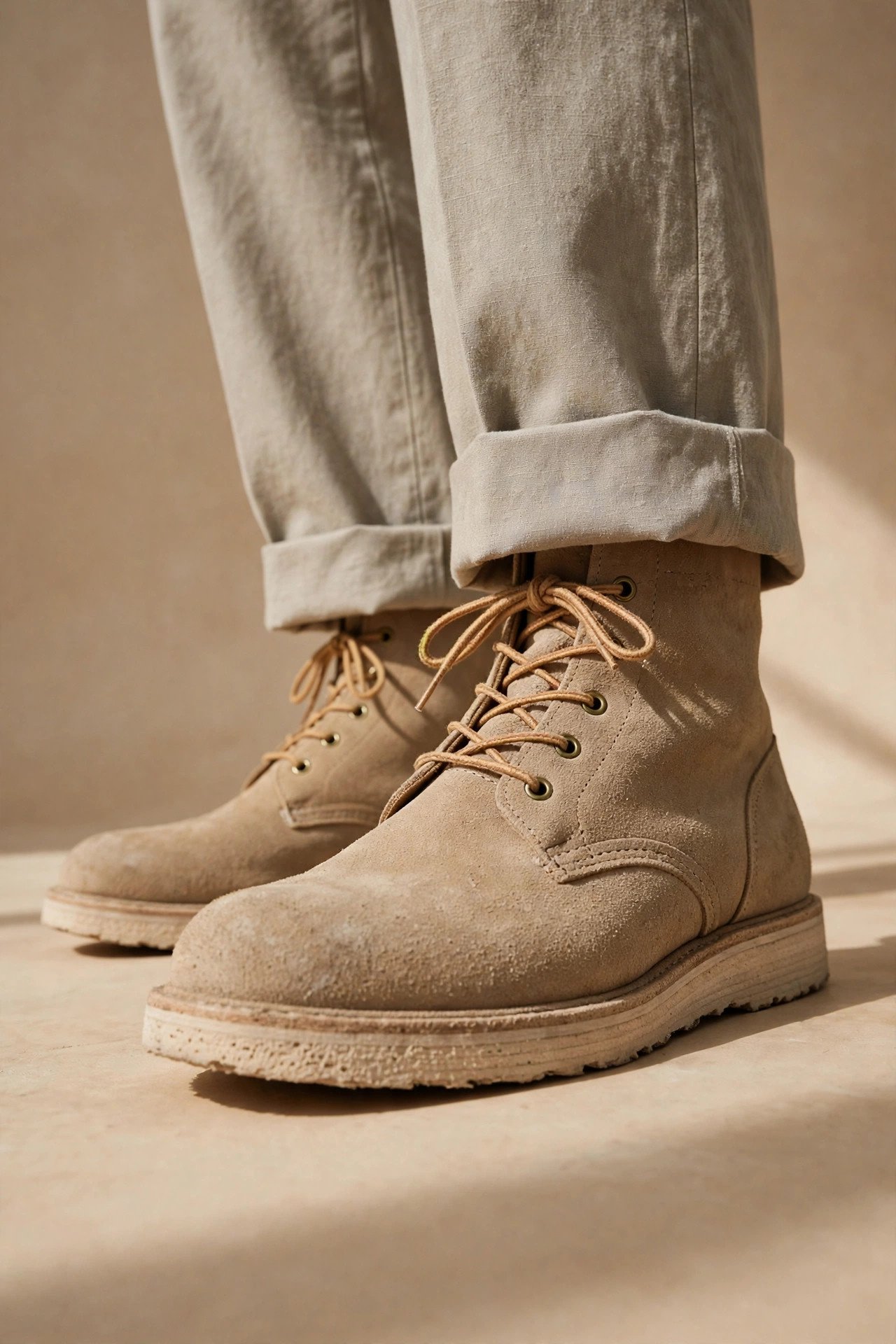
Shoes are the piece people overthink, so let me simplify it: sand-colored suede desert boots with a crepe sole. That is the default answer, and it is the default because it is right. The suede texture is doing half the work of the whole trend — matte, soft, a little dusty, it is the desert in shoe form. The crepe sole keeps them casual enough that the outfit never looks like you are trying too hard. Now, the honest caveat: if boots are not your thing, a dark brown or tan leather loafer does the same job with a dressier finish, and I have worn both versions. Skip white sneakers here, tempting as they are — white sneakers drag the palette toward streetwear and break the tonal spell. One more practical rule I learned the hard way: suede and rain are enemies, so if your fall is a wet one, this is the piece where you switch to the leather loafer and keep the desert boots for dry days.
Piece 5: The Belt + Canvas Satchel (The Duo That Sells It)
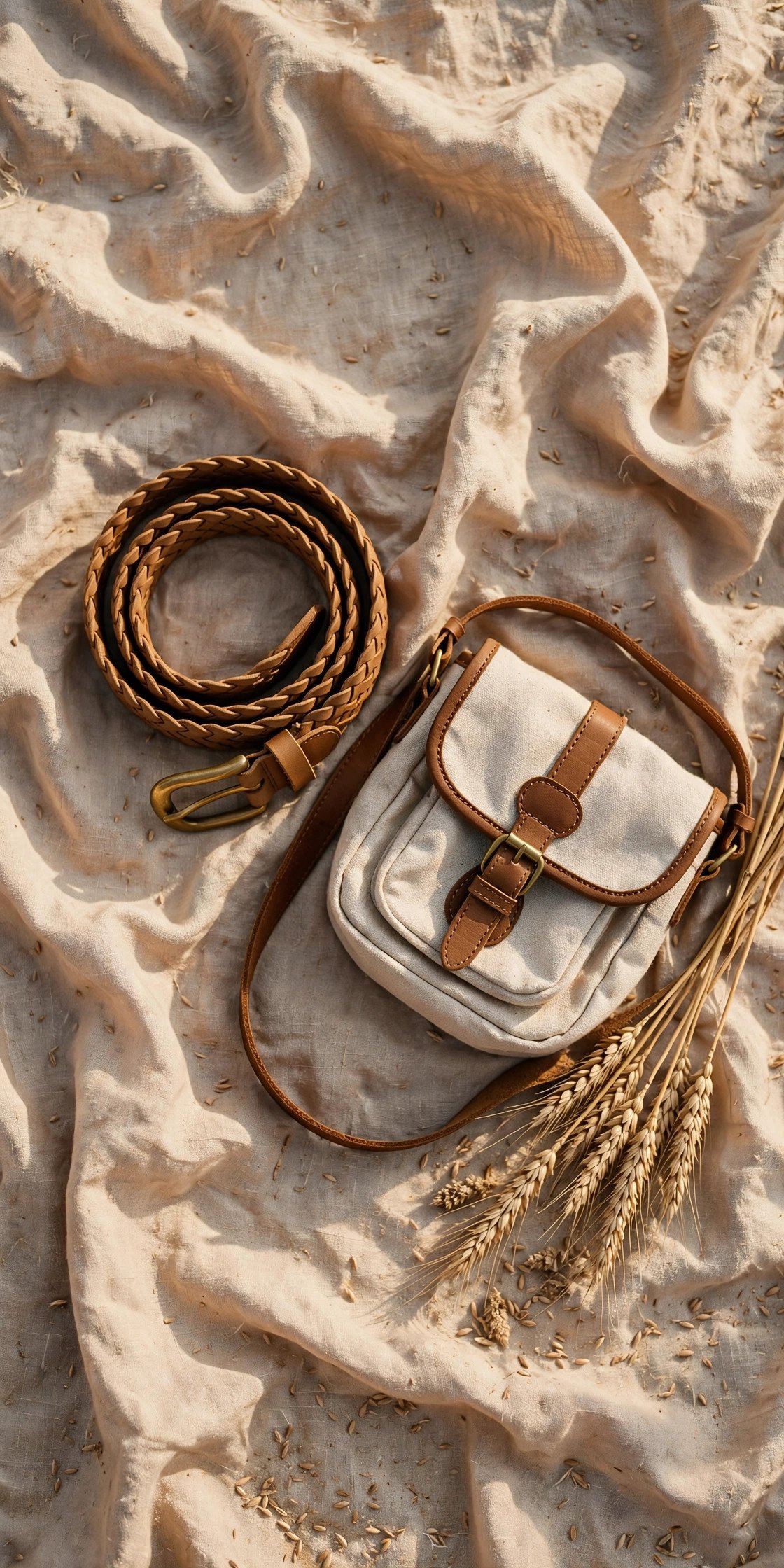
I am counting accessories as one piece because separately they are details, and together they are the signature. First, the belt: woven tan leather, about an inch and a quarter wide. A woven belt matters because its texture breaks up the flat khaki-on-khaki stretches of the outfit — a smooth belt in the same tone just disappears. Second, the canvas satchel: natural canvas with leather straps and brass hardware, worn crossbody or over the shoulder. This is the explorer line of the whole look, the single item that says “coded” without saying “costume.” My opinion on bags for this trend is firm: skip the structured leather handbag and skip the nylon backpack. The structured bag fights the relaxed fabrics, and the backpack turns the whole thing into hiking gear. The canvas satchel sits exactly in the middle — practical, soft, and it ages beautifully. Buy the belt one size up so it works over the field jacket too, not just through trouser loops.
Rule 1: Wear Three Khakis, Never One
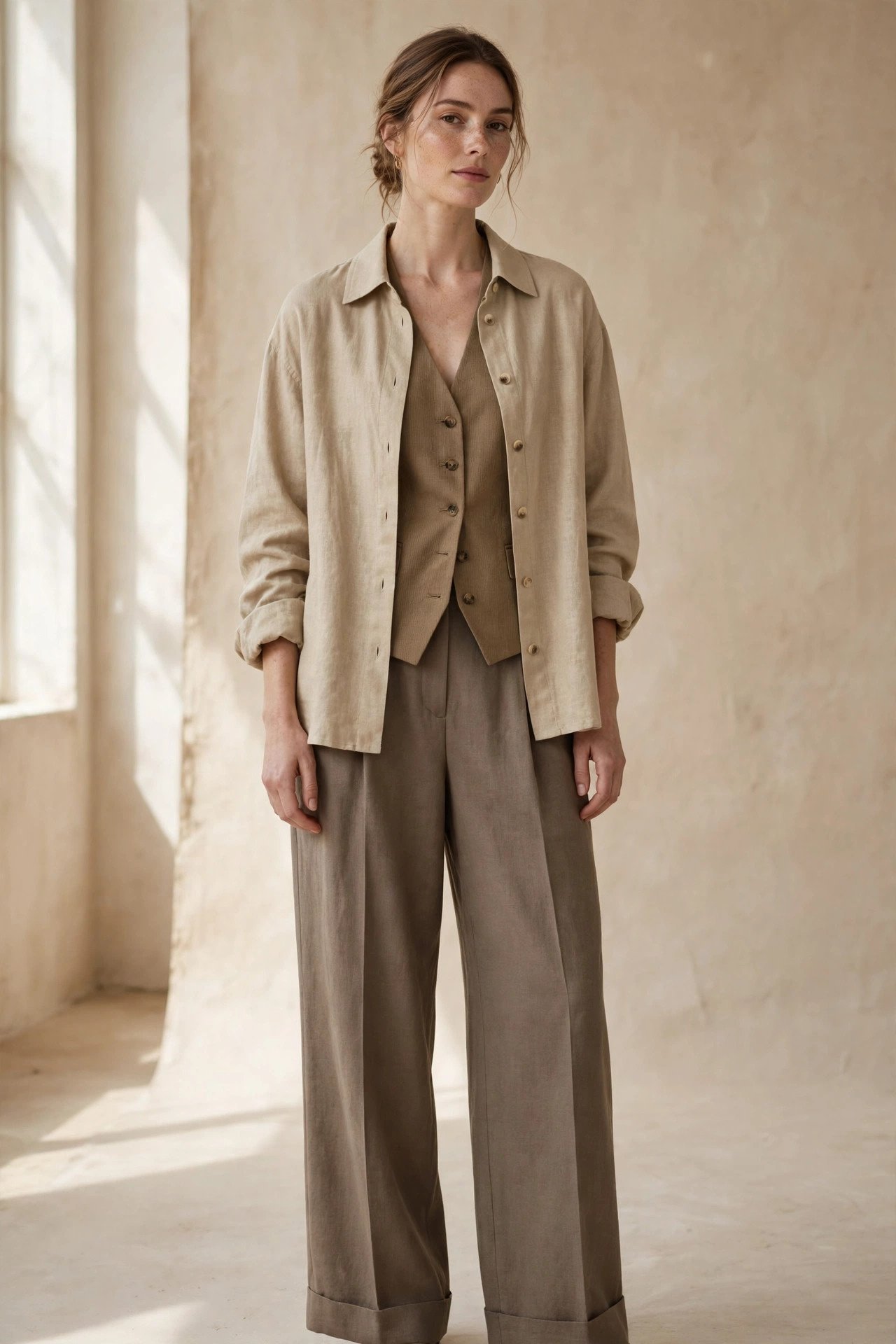
This is the single most important styling rule of the trend, so read it twice: tone-on-tone, never matchy-matchy. The goal is three distinct shades of the desert palette in one outfit — say, a sand shirt, a mid-khaki jacket, and taupe trousers — each visibly different from the others. When every piece is the exact same khaki, the outfit reads as a uniform, and uniforms read as costumes. When the shades step down gradually, it reads as considered and expensive. I keep a mental ladder: lightest on top near the face (sand, stone), medium in the middle (classic khaki, olive), darkest at the bottom (taupe, dark olive) or reversed for evening. If you are ever unsure whether two pieces are too close in shade, they are — swap one. This one rule is the difference between “she is wearing the Khaki Coded trend” and “she just really likes beige,” and trust me, you want the first one.
Rule 2: The Half-Tuck and Rolled Sleeves Are Non-Negotiable
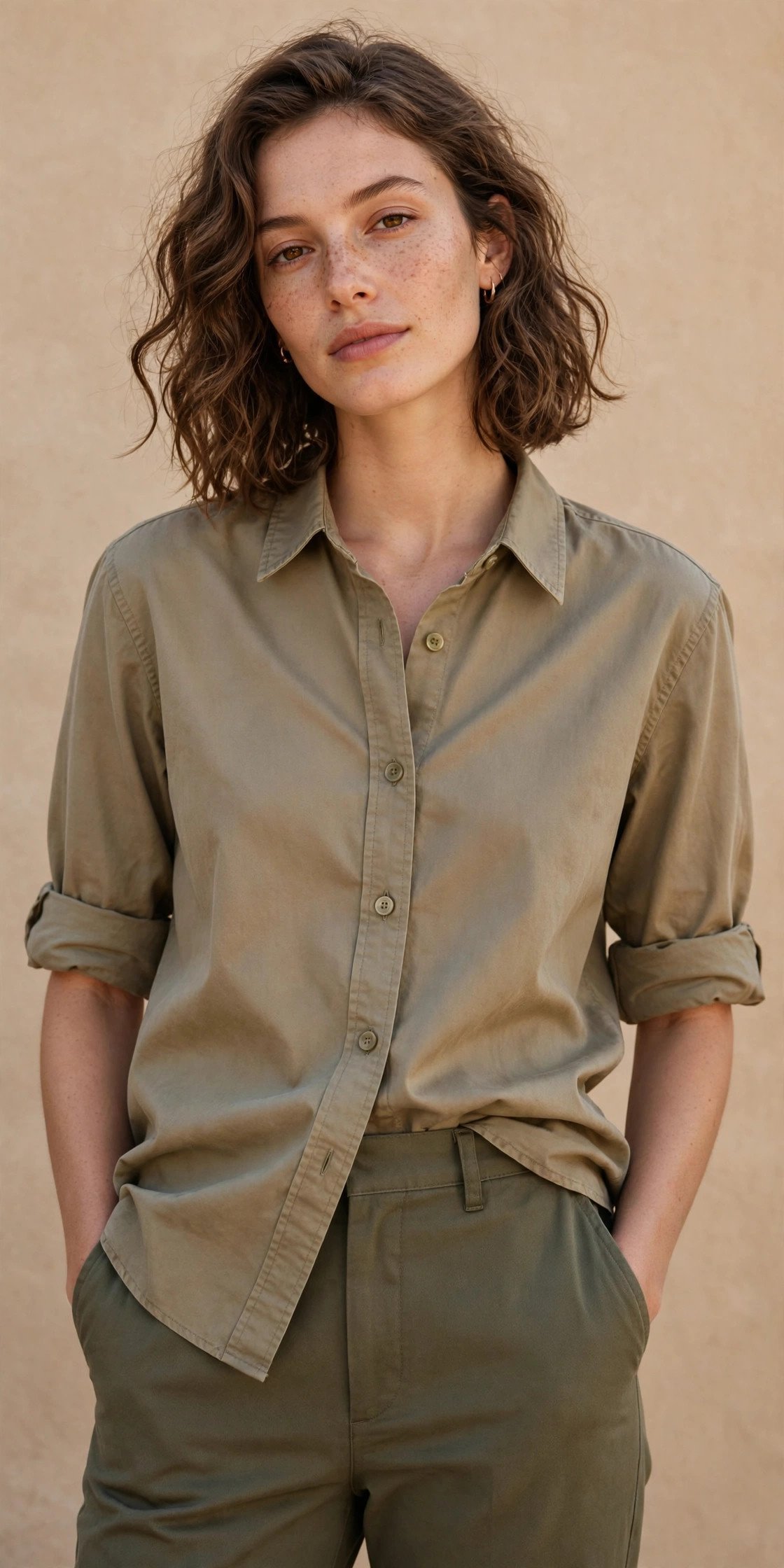
Khaki fabrics are inherently neat — twill, canvas, poplin — which means the whole look can tip into “pressed and proper” if you let it. The fix is styling, not different clothes. The half-tuck — front of the shirt tucked, back left out — is the fastest way to signal that this is fashion, not a uniform inspection. It creates a waistline, shows the belt (which we just established is doing important work), and breaks the long straight line of an untucked shirt. Rolled sleeves do the same job for the arms: push them to just below the elbow, one clean fold, not a tight roll. Here is the part people get wrong — this styling has to look accidental, which means it has to be deliberate. A sloppy tuck looks sloppy; a considered half-tuck looks effortless. Stand in front of a mirror once, get the fold right, and then forget about it. In my experience, these two moves alone rescue about half of all “why does this look off” khaki outfits.
Rule 3: Every Outfit Gets One Dark Anchor
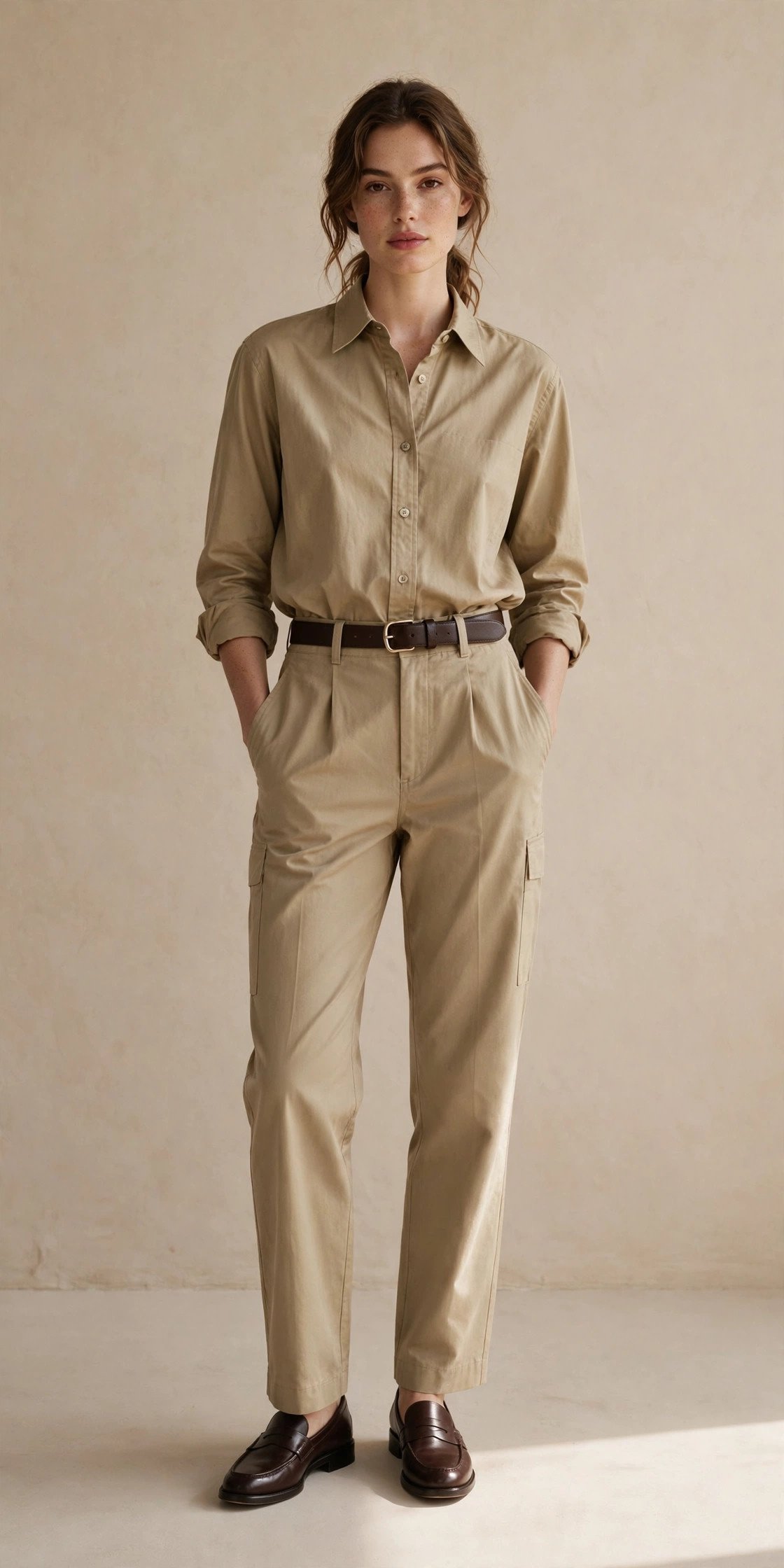
A head-to-toe light palette has a real risk: it can wash you out and make the outfit look like it is floating. The fix is one dark anchor — a single dark brown or espresso element that grounds everything. Dark brown leather belt, dark brown loafers, a deep chocolate bag, even dark tortoiseshell sunglasses. Just one. This is a judgment call I feel strongly about because I have seen the alternative: two or three dark pieces and the khaki stops being the story; zero dark pieces and the outfit has no gravity. The anchor should sit at the waist or the feet — the belt or the shoes — because those are the natural visual endpoints of an outfit. And keep it warm-dark, not black. Black is too harsh against desert tones and drags the palette toward city-minimal, which is a different trend entirely. Dark brown keeps the warmth. This rule is also what makes the look work on deeper skin tones, where all-light outfits can disappear — the anchor gives the eye somewhere to land.
Rule 4: The Weekday Uniform (Utility Shirt + Pleated Trousers + Desert Boots)
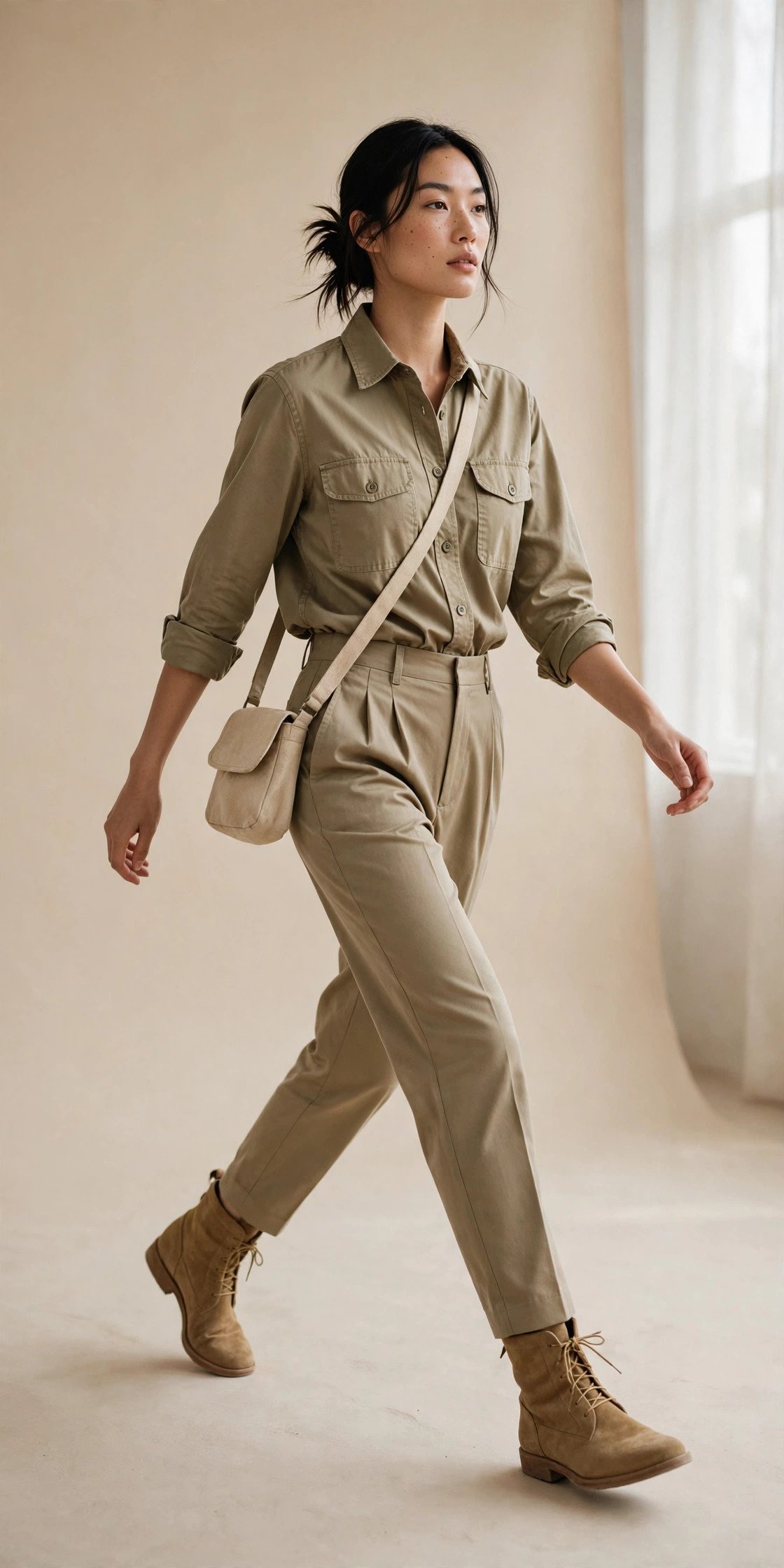
Here is the formula for the days you do not want to think: utility shirt (half-tucked, sleeves rolled) + pleated khaki trousers + desert boots + canvas satchel. Four pieces, five minutes, done. This is the outfit I wore most during my two weeks of testing, and it handled everything — work calls, market runs, an evening out — without a single change. Why it works: the shirt and trousers are in two different khaki shades (Rule 1), the tuck and sleeves keep it relaxed (Rule 2), and the boots plus belt give it the dark anchor (Rule 3). For cooler mornings, throw the field jacket over it and you have added a third shade without thinking. The only decision you make is which shade goes where, and after three wears it becomes automatic. If you are building this trend on a budget, this formula is also your shopping list in priority order — shirt first, trousers second, boots third, because those three alone make the outfit and the rest is refinement.
Rule 5: The Desert-Evening Formula (Field Jacket + Dress + Belt)
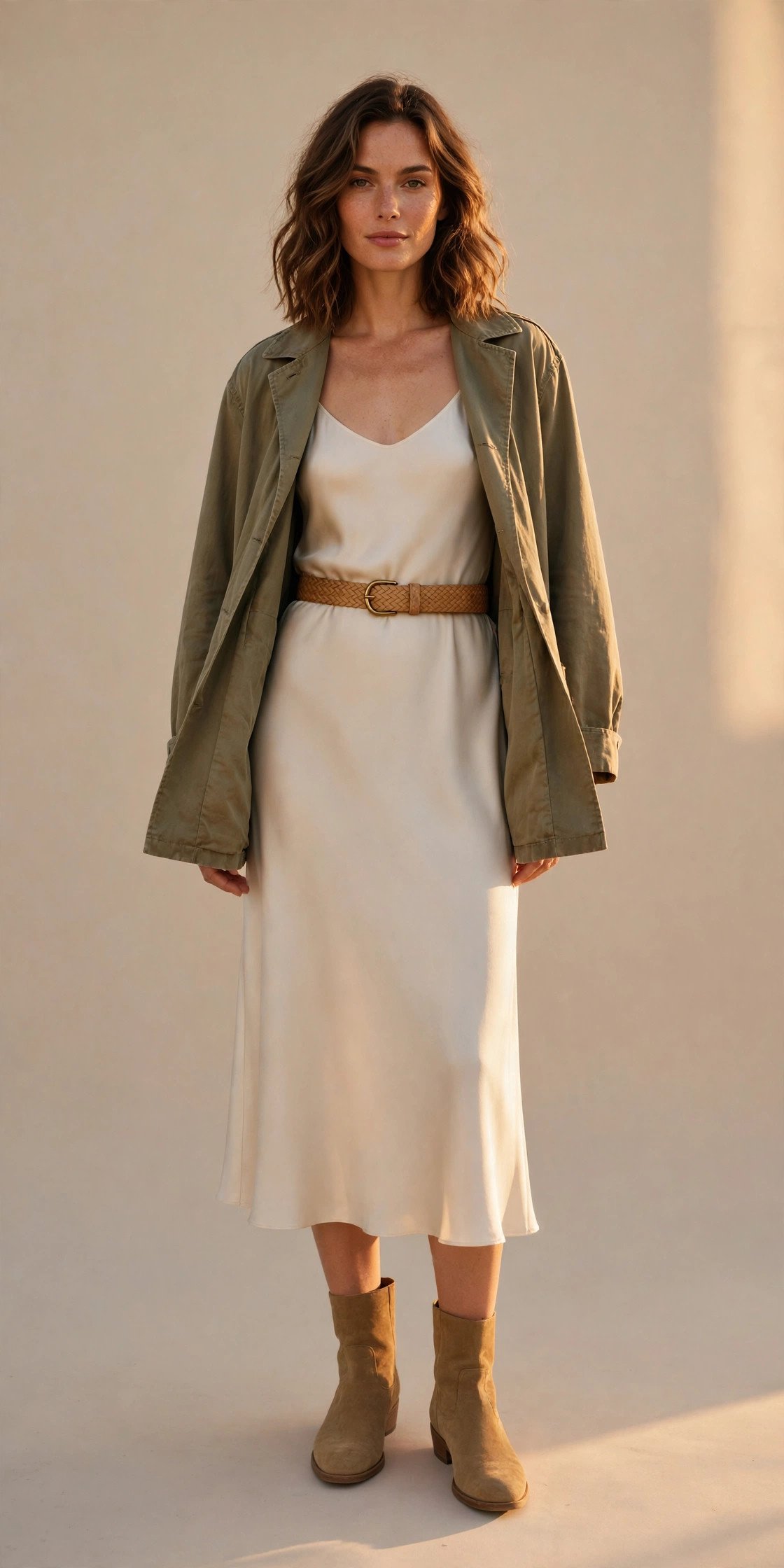
Khaki Coded does not clock out at 6 PM — it just changes register. The evening formula: your field jacket worn open over a simple cream or champagne slip dress, cinched at the waist with the woven belt over the jacket, finished with suede ankle boots. The jacket-over-dress move is doing two things at once: the dress keeps it feminine and evening-appropriate, while the jacket keeps the desert-toned story going. Wearing the belt over the jacket instead of under it is the detail that makes this look intentional rather than “I got cold and grabbed a jacket.” My opinion: this is the outfit that converts skeptics. Everyone who thinks khaki is boring has never seen it done in silk and suede at golden hour. Keep jewelry minimal — small gold hoops are enough — because the texture contrast between the rugged jacket and the fluid dress is already the whole conversation. This formula also proves the larger point of this guide: the same five pieces, rearranged, take you from a Tuesday to a Saturday night.
The Bottom Line
Khaki Coded endures because it was never really about the desert — it is about a palette of honest, hardworking neutrals that flatter almost everyone and pair with almost everything. Five pieces, five rules, and a closet you mostly already own. That is the whole trend, and honestly, it is one of the most wearable ones Pinterest has predicted in years. Start with the utility shirt this week. The rest will follow.
For more fall 2026 fashion guides, see my cool blue outfit ideas and poetcore outfits for fall — and if you like trend pieces with a strong opinion, my week testing the Glamoratti trend is worth a read.
Frequently Asked Questions
What is the Khaki Coded trend?
Khaki Coded is a Pinterest Predicts 2026 fashion trend built around desert-inspired neutrals — khaki, sand, taupe, camel, and olive. Think explorer-adjacent pieces like utility shirts, field jackets, and pleated trousers styled as modern everyday outfits, not costumes.
Is Khaki Coded just safari style?
No — and that distinction is the whole point. Safari style copies expedition gear literally; Khaki Coded borrows the palette and a few utility details (pockets, belts, canvas) and applies them to normal modern silhouettes. If it looks like a costume, it is being done wrong.
What colors count as khaki for this trend?
The working palette is sand, stone, classic khaki, taupe, camel, and muted olive. The key rule is wearing three distinct shades in one outfit rather than one flat matching khaki — tone-on-tone is what makes it look expensive.
Do I need to buy all 5 pieces?
Almost certainly not. Most wardrobes already hold a khaki or olive button-up, some kind of neutral trousers, and brown shoes or a belt. Audit your closet first — in my experience, people typically need to add only one or two pieces, usually the field jacket or the desert boots.
What shoes go with the Khaki Coded look?
Sand suede desert boots are the default, with a dark brown or tan leather loafer as the dressier alternative. Skip white sneakers — they break the tonal palette and pull the outfit toward streetwear.
How do I wear khaki without looking washed out?
Two fixes: wear three different shades instead of one flat khaki, and add one dark anchor — a dark brown belt, shoes, or bag — to ground the outfit. The anchor gives the eye somewhere to land and keeps light tones from floating.
Is Khaki Coded office-appropriate?
The weekday formula absolutely is: a tucked utility shirt, pleated khaki trousers, and loafers read as smart-casual in most workplaces. Keep the cargo pockets subtle and the boots polished, and it passes everywhere a blazer-and-chinos dress code does.
Can I wear Khaki Coded in winter too?
Yes — the palette is seasonless. Layer a camel wool coat over the field jacket, swap the boots for dark brown leather ones, and add a chunky cream knit. The desert tones actually look richer against winter light.
Mehboob Hussain is the founder and editor of MubStyle, where he covers fashion, beauty, home decor and wellness. He researches and writes every article himself — testing each idea for real life before it makes the list — and creates original visuals for every guide. Based in Multan, Pakistan.

Mehboob Hussain is the founder and editor of MubStyle, where he covers fashion, beauty, home decor and wellness. He researches and writes every article himself — testing each idea for real life before it makes the list — and creates original visuals for every guide. Based in Multan, Pakistan.